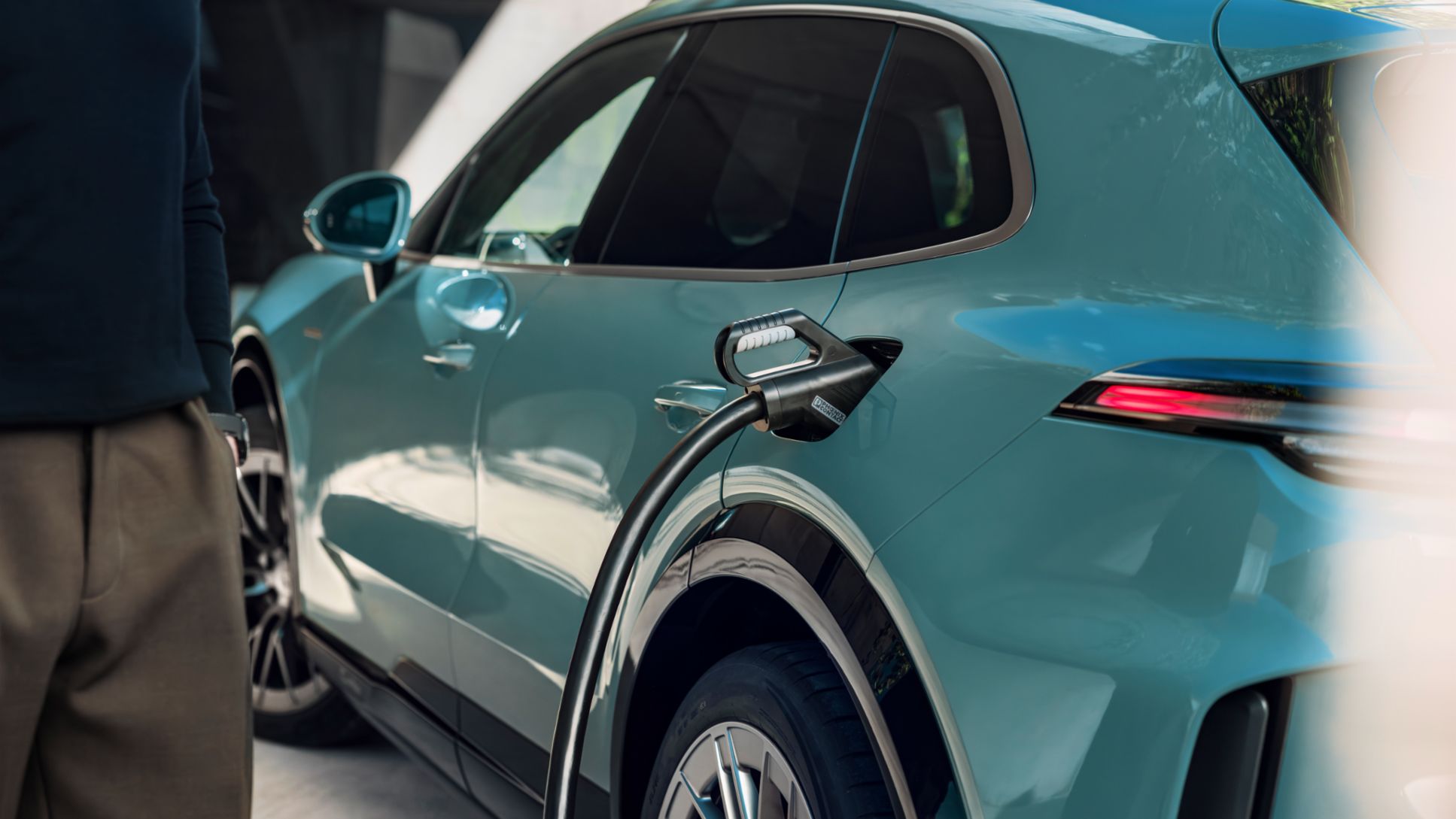
Those who want to cover ground as quickly as possible on long journeys can rely on the Cayenne Electric’s (Cayenne Electric (WLTP)*: Electrical consumption combined: 21.8 – 19.7 kWh/100 km; CO₂ emissions combined: 0 g/km; CO₂ class: A) extremely high charging capacity. Thanks to 800-volt technology, the Cayenne can charge at up to 390 kW at a suitable DC charging point and, under specific conditions, a rate of up to 400 kW¹ can even be achieved. The SoC (State of Charge) can be increased from 10 to 80 per cent in less than 16 minutes², and sufficient energy for an additional 325 km (Cayenne) or 315 km (Cayenne Turbo (Cayenne Turbo Electric (WLTP)*: Electrical consumption combined: 22.4 – 20.4 kWh/100 km; CO₂ emissions combined: 0 g/km; CO₂ class: A)) of range can be added within 10 minutes³. One of the main areas of focus during development was robust charging performance.
At 400-volt charging stations, the 800-volt battery is effectively divided into two batteries, each with a nominal voltage of 400 volts, using a high-voltage switch in the battery. This method, known as bank charging, enables particularly efficient charging without an additional HV booster – at an output of up to 200 kW. With typical household wallboxes, AC charging is possible with the standard onboard charger at up to 11 kW, and a 22 kW onboard charger is also available as an option.
The Cayenne Electric keeps its driver informed in real time about every active charging process. Charging time, range, charge level, charging rate and battery temperature are displayed in the Porsche Communication Management (PCM) system and the My Porsche app. If the full charging performance cannot be achieved, for example because the battery temperature is too low, then this is also clearly communicated to the customer. Information about the current charging status is also given via the LED indicator in the standard electric charging flap and the Communication Light in the interior, with a corresponding LED animation.
----
¹Cayenne charging capacity under specific conditions with a CCS fast charging station supplying > 400 kW, > 850 V, > 520A, with an initial state of charge of 45 – 48 per cent and a battery temperature of 40°C - 42°C. Maximum charging power with direct current (DC) during charging from 10 per cent SoC to up to 80 per cent SoC under optimal conditions: 390 kW (CCS fast charging station supplying > 390kW, > 850 V, > 520A, with a battery temperature of 15°C, initial state of charge of 9 per cent and remaining range < 60 km).
²Cayenne Charging time with direct current (DC) at maximum charging power from 10 per cent SoC up to 80 per cent SoC under optimal conditions (CCS fast charging station supplying > 390kW, > 850 V, > 520A, with a battery temperature of 15°C, initial state of charge of 9 per cent and remaining range < 60 km).
³Cayenne range added in 10 minutes of charging with direct current (DC) at maximum charging power under optimal conditions (CCS fast charging station supplying > 390 kW, > 850 V, > 520A, with a battery temperature of 15°C, initial state of charge of 9 per cent and remaining range < 60km), based on WLTP consumption of a vehicle with standard equipment according to German market specification.